5 Hidden Features of the Hd 490 Pro You Must Know About
When professional monitoring headphones enter the market, they are often judged by the standard metrics of frequency response, impedance, and soundstage width. While the Sennheiser HD 490 Pro excels in these foundational areas, many users overlook the engineering nuances that truly define its "Pro" designation. This open-back reference headphone was designed during an era where the lines between home project studios and high-end commercial facilities have blurred. Producers, mix engineers, and mastering specialists now require tools that are as adaptable as their workflows. Beyond its sleek, industrial exterior lies a suite of features designed to solve the practical, day-to-day frustrations of audio professionals.
The HD 490 Pro represents a significant shift in design philosophy for Sennheiser’s professional line. It isn't just a successor to a previous model; it is a ground-up reimagining of what a critical listening tool should be in the age of immersive audio and software-driven correction. By looking past the initial specifications, we can uncover several design choices that significantly impact the longevity, comfort, and, most importantly, the translatability of your mixes. Understanding these hidden features is essential for getting the most out of your investment and ensuring your monitoring environment is as accurate as possible.
Detailed Product Analysis: Engineering for Precision
The HD 490 Pro utilizes a high-performance 38mm dynamic transducer that employs a specialized neodymium magnet system. This provides the necessary flux density to maintain control over the diaphragm during transient peaks, ensuring that drum hits and sharp synth attacks remain crisp and clear without the "smearing" often associated with less rigid driver assemblies. The open-back architecture is not merely for show; the honeycomb grilles are mathematically optimized to minimize internal reflections, which can lead to phase cancellation or additive resonance in the high-mid frequencies.
Central to its performance is the Open-frame Architecture. Most headphones suffer from a buildup of acoustic pressure behind the driver, which can impede the diaphragm's movement. Sennheiser solved this by creating a housing that offers as little resistance as possible to the rear-firing energy of the transducer. This results in a cleaner, more extended low-end response that feels natural rather than boosted. In an industry where low-frequency management is the hallmark of a professional mix, having a headphone that doesn't exaggerate the 60Hz to 100Hz region is vital for making decisions that actually translate to club systems and home theaters.
Furthermore, the internal geometry of the earcups is designed to accommodate the pinna (the outer ear) without causing uncomfortable contact. This spatial awareness within the cup helps in the perception of depth and height, which is particularly beneficial for those working in Dolby Atmos or other spatial audio formats. When the ear is positioned correctly relative to the driver, the binaural cues used to localize sound in a virtual environment are far more convincing and reliable.
1. Dual-Path Frequency Response Tuning via Ear Pads
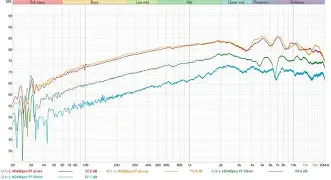
One of the most significant yet under-discussed features of the HD 490 Pro is the inclusion of two distinct sets of ear pads: the "Producing" pads and the "Mixing" pads. While many headphones offer replacement pads, these are functionally different acoustic filters. The Producing pads (velour-style) provide a slightly warmer, more musical sound profile. They have a subtle lift in the lower frequencies that helps inspire creativity during the tracking and arrangement phases. It makes the monitoring experience more enjoyable, which is crucial during long production sessions where "clinical" sound can lead to ear fatigue.
On the other hand, the Mixing pads (fabric-style) are designed for absolute transparency. They flatten the frequency response, particularly in the mid-range and high-end, allowing the engineer to hear every flaw, harsh frequency, or imbalance in the stereo field. This dual-pad approach acknowledges that the needs of a producer at the start of a project are different from those of a mix engineer at the end. Switching the pads essentially gives you two different "tunings" in a single chassis, eliminating the need to swap between different headphone models to gain a new perspective on a track.
2. The Innovative Dear Reality dearVR MIX-SE Integration
In modern audio engineering, the "room" is often the most significant variable. The HD 490 Pro addresses this by including a license for the Dear Reality dearVR MIX-SE plugin. This software is specifically tuned to the acoustic profile of the HD 490 Pro. It uses advanced spatial modeling to place the listener in a virtual "ideal" mixing room. Many users see this as a mere add-on, but it is a fundamental part of the monitoring system. It creates a virtual out-of-head localization that mimics the experience of sitting in front of high-end studio monitors.
Discover deals on Audio & Headphones — updated daily.
See Deals →This integration solves the "inside the head" feeling that plagues traditional headphone mixing. By simulating the crossfeed and room reflections of a calibrated control room, the engineer can make better decisions regarding the width and depth of the soundstage. You can virtually check your mix in different environments—like a car, a club, or a living room—knowing that the software corrected the headphone's output to match the target environment. This synergy between hardware and software ensures that "bedroom" mixes can compete with those produced in multi-million dollar facilities.
3. Geometric Load-Distribution Headband Design
Comfort is often treated as a secondary metric, but for a professional, it is a performance metric. If a headphone causes physical pain after two hours, your ability to make critical decisions diminishes. The HD 490 Pro features a unique headband design that uses a variable-tension system to distribute weight away from the sensitive crown of the head. Rather than a singular point of contact, the pressure is spread across the temples and the side of the skull.
This "hidden" engineering feat involves the use of specialized hinges that allow the earcups to pivot freely in three dimensions. This ensures that the seal—which is critical for bass response—remains consistent regardless of the listener's head shape or whether they wear glasses. For glass wearers, many headphones lose up to 10dB of low-end due to a broken seal at the temples. The HD 490 Pro’s pad materials and hinge geometry are designed to wrap around the arms of glasses, maintaining the intended frequency response and preventing bass leakage.
4. Symmetrical Cable Attachment Points
A small but revolutionary feature for workflow is the ability to attach the cable to either the left or right earcup. While this might seem like a simple convenience, in a busy studio environment, cable management is a constant battle. If your audio interface or headphone amp is on your right side, having a cable cross over your body to the left earcup is distracting and can lead to the cable getting caught in chair wheels or snagging on gear.
The HD 490 Pro features a patented internal wiring system that allows for this versatility without compromising signal integrity or stereo imaging. Moreover, the cable itself features a mini-coil near the attachment point. This serves as a strain relief and a "buffer" against microphonics (the sound of the cable rubbing against your clothes). If the cable is accidentally jerked, the coil expands, preventing damage to the internal connectors or the headphone jack on your interface.
5. Sustainable Architecture and Maintenance-First Construction
Professional gear should be a lifetime investment, not a disposable commodity. Sennheiser has designed the HD 490 Pro with a modular philosophy. Every high-wear component—from the headband padding and the ear pads to the cable and even the internal dust filters—is user-replaceable. This is a "hidden" feature in an era of planned obsolescence. The ability to deep-clean or replace the fabric elements is especially important in commercial studios where multiple people might use the same pair of headphones.
Furthermore, the materials used are highly durable yet lightweight. The chassis uses a combination of metal reinforcements and high-grade polymers that can withstand the rigors of travel and frequent use. Even the ear pads are washable, which is a rare feature in the high-end headphone market. This commitment to longevity means that the HD 490 Pro maintains its value over time, serving as a reliable reference point for years of professional work.
Pros and Cons
- Pro: Exceptionally flat and honest frequency response with the Mixing pads, making it one of the most reliable mastering tools available.
- Pro: The lightweight, open-frame design allows for 8-10 hour sessions without the physical fatigue associated with heavier planar magnetic headphones.
- Pro: Excellent integration with spatial audio workflows thanks to the included Dear Reality software and the physical driver positioning.
- Pro: Versatile cable management with the dual-sided input and the microphonics-reducing coil design.
- Con: Being an open-back design, it provides almost zero isolation, making it unsuitable for tracking loud instruments like drums or for use in noisy public spaces.
- Con: The "Producing" pads may sound a bit too forgiving for those who prefer a strictly clinical sound at all times.
- Con: High-end professional pricing reflects its status as a specialized tool rather than a casual listening device.
Comparison with Industry Standards
To understand where the HD 490 Pro sits in the broader market, it is helpful to compare it against other industry-standard headphones used in professional environments.
Find top-rated Audio & Headphones products at great prices.
View Offers →| Feature | Sennheiser HD 490 Pro | Sennheiser HD 600 | Beyerdynamic DT 1990 Pro |
|---|---|---|---|
| Design Type | Open-Back Dynamic | Open-Back Dynamic | Open-Back Dynamic |
| Primary Use Case | Mixing, Mastering, Spatial Audio | Referencing, Critical Listening | Editing, Mixing |
| Frequency Response | 5 Hz - 36,000 Hz | 12 Hz - 40,500 Hz | 5 Hz - 40,000 Hz |
| Included Accessories | Two pad sets, dearVR MIX-SE, Case | Detachable cable only | Two pad sets, coiled/straight cables |
| Weight (without cable) | 260g | 260g | 290g |
| Cable Connectivity | Left or Right Sided | Fixed Dual-Sided | Left Sided Only |
Buying Guide: Is the HD 490 Pro Right for Your Studio?
Choosing the right monitoring tool depends heavily on your environment and the specific tasks you perform daily. If you are a Mixing or Mastering Engineer, the HD 490 Pro is almost a mandatory consideration. Its ability to switch between a musical and a clinical profile via the ear pads offers a level of versatility that is rare in this price bracket. Those who struggle with mixes that sound "muddy" or "boomy" on other systems will find the HD 490 Pro's low-end clarity to be a revelation.
For Content Creators and Podcasters, the benefits are less about frequency response and more about comfort and the dual-sided cable. If you spend your day editing dialogue and arranging clips, the lightweight nature of these headphones will be their most appreciated feature. However, keep in mind that since they are open-back, your microphone will likely pick up "bleed" from the headphones if you use them while recording. For that reason, they should be paired with a set of closed-back headphones for tracking purposes.
For those working in Immersive and Spatial Audio, the HD 490 Pro was essentially built for you. The partnership with Dear Reality and the geometric alignment of the drivers provide an "out-of-head" localization that is necessary for placing objects in a 3D sound field. If you are moving from stereo to Dolby Atmos mixing, these headphones provide a cost-effective way to monitor your spatial movements without investing immediately in a 7.1.4 speaker array.
When considering the purchase, evaluate the "Total Cost of Ownership." While the initial price is higher than entry-level monitors, the inclusion of premium software, two sets of pads, and a rugged carrying case (in the Plus version) adds significant value. Moreover, the user-serviceable nature of the design ensures you won't be replacing the entire unit every three years due to worn-out parts.
Conclusion: A New Benchmark for Professional Monitoring
The Sennheiser HD 490 Pro is a testament to the idea that professional gear should be more than the sum of its technical specifications. By focusing on the "hidden" aspects of the user experience—such as acoustic pad tuning, ergonomic weight distribution, and integrated virtual room software—Sennheiser has created a tool that respects the workflow of the modern engineer. It acknowledges that mixing is as much a physical and psychological process as it is a technical one.
Whether you are trying to solve a persistent problem with low-end translation or you are looking for a headphone that you can wear for a twelve-hour session without discomfort, the HD 490 Pro offers solutions that go beyond simple frequency charts. It is an honest, transparent, and remarkably adaptable piece of equipment that provides the clarity needed to make confident decisions. In the fast-paced world of professional audio, that confidence is the most valuable feature a tool can provide.